
Boston's Wastewater Infrastructure Faces Compliance and Capacity-Driven Investment
Boston's wastewater infrastructure is experiencing substantial investment and planned upgrades, largely propelled by stringent regulatory compliance and the need to modernize aging systems. This sustained activity in capital planning, funding allocation, and engineering design provides early indicators of upcoming project opportunities for informed commercial teams.
Boston's Wastewater Investment Driven by Regulatory Mandates and System Modernization
The Infrastructure Project Lifecycle
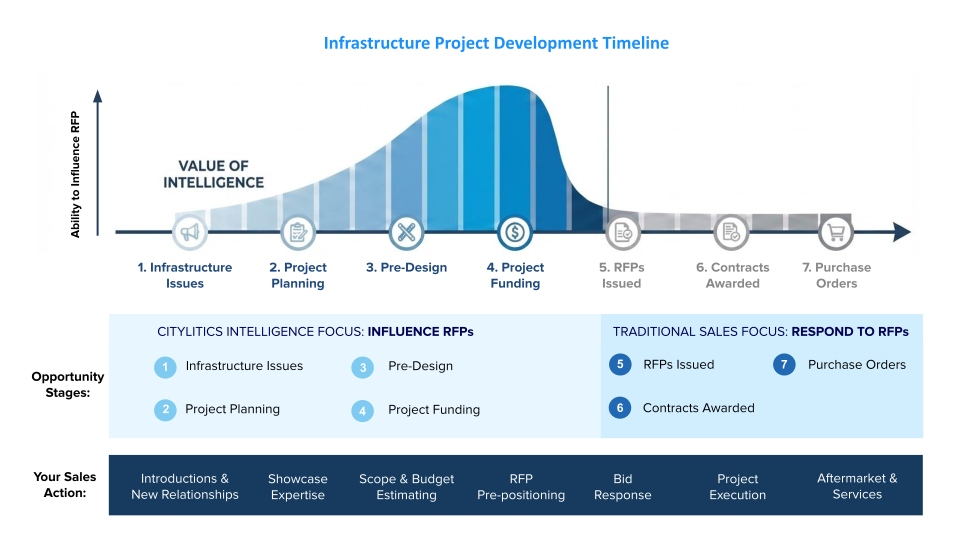
Where Boston Wastewater Work Is Planning, Procurement, or Construction
The shift into pursuit preparation occurs when scope and delivery are defined, not when the capital need first appears.
Suppliers can still monitor contract sequencing, construction updates, downstream requirements, and any future packages, while using BWSC's broader CIP to find projects that have not yet passed through procurement.
Those records distinguish a long-range need from funded engineering, and funded engineering from a bid-ready package, so pursuit effort can increase only when the project stage supports it.
Early Project Signals in Boston Wastewater Infrastructure
Similar Regions in This Market
Citylitics for Boston Wastewater Project Tracking
Commercial Signals Before Procurement
Project pages and award records should be checked before describing any construction-stage program as an upcoming RFP or bid.
PROJECT INTELLIGENCE FAQ
Frequently Asked Questions
Where can suppliers monitor Boston wastewater projects before bids are released?
Follow BWSC's Capital Improvement Program, project pages, Commission actions, and procurement notices for City-owned water and sewer work. For regional wastewater infrastructure, follow MWRA capital plans, Board actions, and procurement records. The planning documents identify needs and planned investment; the owner actions and procurement records show when a specific project has advanced into design, package authorization, or solicitation.
Where can suppliers monitor Boston wastewater projects before bids are released?
Follow BWSC’s Capital Improvement Program, project pages, Commission actions, and procurement notices for City-owned water and sewer work. For regional wastewater infrastructure, follow MWRA capital plans, Board actions, and procurement records. The planning documents identify needs and planned investment; the owner actions and procurement records show when a specific project has advanced into design, package authorization, or solicitation.
Which Boston wastewater programs are already in construction?
BWSC's current East Boston Sewer Separation page states that Phase IV is being delivered through five construction contracts running from 2025 into 2031. South Boston sewer-separation work is also being delivered in phases. These projects are evidence of significant wastewater investment. The base construction packages are delivery-stage work unless BWSC advertises a new contract or package.
Which Boston wastewater programs are already in construction?
BWSC’s current East Boston Sewer Separation page states that Phase IV is being delivered through five construction contracts running from 2025 into 2031. South Boston sewer-separation work is also being delivered in phases. These projects are evidence of significant wastewater investment. The base construction packages are delivery-stage work unless BWSC advertises a new contract or package.
When should a seller move from monitoring to active pursuit on a Boston wastewater project?
A master-plan need or CIP line is a monitoring signal. Move into pursuit preparation when BWSC or MWRA authorizes funded design, selects an engineering path, defines a delivery package, or takes a Board/Commission action that materially advances the project. Move into active pursuit when an RFQ, RFP, bid, or other formal solicitation matching the firm's scope is released.
When should a seller move from monitoring to active pursuit on a Boston wastewater project?
A master-plan need or CIP line is a monitoring signal. Move into pursuit preparation when BWSC or MWRA authorizes funded design, selects an engineering path, defines a delivery package, or takes a Board/Commission action that materially advances the project. Move into active pursuit when an RFQ, RFP, bid, or other formal solicitation matching the firm’s scope is released.
Sources and Methodology
Sources & Intelligence Methodology
Market and geographic context on this page is informed by official plans, budgets, capital programs, board materials, public records, and other government or public-owner sources. The early-stage project signals and pre-RFP opportunity previews are provided separately through Citylitics’ proprietary sales intelligence platform, which continuously identifies and tracks infrastructure opportunities as they develop toward procurement.
Massachusetts Water Resources Authority | 2018 master plan
Summarizes MWRA long-range infrastructure needs, including the number of projects and estimated 40-year investment identified in the master plan.
Massachusetts Water Resources Authority | 2023
Reports the documented reduction in typical-year Charles River Basin combined-sewer-overflow volume and the supporting assessment findings.
Boston Water and Sewer Commission | 2026
Lists BWSC planned capital work, program objectives and 2026 system-inspection targets for water, sewer and drainage infrastructure.
TL;DR
Boston's strongest current wastewater evidence is a combination of long-range MWRA investment needs and BWSC capital work, but several high-profile sewer-separation projects are already in construction.
East Boston Sewer Separation Phase IV is being delivered through five construction contracts, so it should be treated as construction-stage work rather than an upcoming prime bid.
Monitor BWSC CIP/project records and MWRA Board/capital actions for funded design, package authorization, and solicitation notices that identify the next wastewater project moving toward procurement.
