Opens in a new tab
Houston, TX · Public Infrastructure

Houston, TX Public Infrastructure Projects: 2027-2031 Water, Wastewater and Street Capital Programs

Houston, TX public infrastructure projects are backed by an adopted 2027-2031 Capital Improvement Plan with major programs in water, wastewater and street infrastructure. Houston's Water Utility System plan allocates about $5.06 billion, the Wastewater Treatment System plan allocates about $3.54 billion, and Street and Traffic Control carries about $1.58 billion. The wastewater system includes roughly 6,200 miles of sanitary sewer lines. These are adopted five-year program allocations, and individual projects move through their own design, construction and procurement schedules.

Houston TX public infrastructure projects
$5.06B
Adopted FY2027–31 water-system allocation. Source: Houston Water Utility CIP (2026).
$3.54B
Adopted FY2027–31 wastewater allocation. Source: Houston Wastewater CIP (2026).
$1.58B
Adopted FY2027–31 streets/traffic allocation. Source: Houston Street & Traffic CIP (2026).
6,200 miles
Approx. sanitary sewer network length. Source: Houston Wastewater CIP (2026).
Market outlook

Houston Public Infrastructure: Adopted 2027-2031 Capital Programs

Houston's adopted 2027-2031 Capital Improvement Plan provides a current five-year view of infrastructure delivery. The Water Utility System chapter allocates about $5.06 billion and continues work on water treatment, transmission, main replacement, storage and pumping assets. The Wastewater Treatment System chapter allocates about $3.54 billion across a network of roughly 6,200 miles of sanitary sewer, more than 380 lift stations and 39 treatment plants. The Street and Traffic Control chapter allocates $1.58 billion, including $790 million for citywide street and traffic rehabilitation and $512.7 million for thoroughfares and collectors. Each program contains projects at different delivery stages, so project profiles and procurement records remain the source for project-specific timing.
$5.06B
Adopted FY2027–31 water-system allocation. Source: Houston Water Utility CIP (2026).
$3.54B
Adopted FY2027–31 wastewater allocation. Source: Houston Wastewater CIP (2026).
$1.58B
Adopted FY2027–31 streets/traffic allocation. Source: Houston Street & Traffic CIP (2026).
6,200 miles
Approx. sanitary sewer network length. Source: Houston Wastewater CIP (2026).
Water capital is concentrated in treatment, transmission and system renewal
Houston's adopted Water Utility System CIP allocates about $5.06 billion for FY2027-2031. The plan continues replacement of East Water Purification Plants 1 and 2, raw-water supply improvements, water-main replacement, transmission construction and rehabilitation of wells, storage tanks and pump stations. The program gives water-sector firms a current owner-backed view of asset classes and five-year capital direction. Individual project profiles and City procurement records establish exact design, construction and contracting schedules.
Wastewater investment combines consent-decree work and asset renewal
The adopted wastewater CIP allocates about $3.54 billion over FY2027-2031. Houston describes a system with approximately 6,200 miles of sanitary sewer, more than 380 lift stations and 39 wastewater treatment plants. Planned work includes neighborhood sewer rehabilitation, force-main and lift-station renewal, treatment-plant upgrades, large-diameter sewer rehabilitation and facility consolidation. The program also implements commitments under the City's 2021 consent decree with EPA and TCEQ. The five-year allocation is concentrated heavily in construction, with design funding also scheduled across the program period.
Street funding covers rehabilitation, thoroughfares and local networks
Houston's adopted Street and Traffic Control CIP allocates $1.58 billion for FY2027-2031. The chapter includes $790 million for citywide street and traffic rehabilitation, $512.7 million for thoroughfares and collectors, $153.7 million for local streets and additional sidewalk and district-service funding. The plan also lists projects deferred to future CIPs when additional funding is needed, which makes project-level stage verification important before treating a listed corridor as current construction. Those program totals identify current coverage priorities. Project-level records determine the construction stage for each corridor listed in the chapter.
Infrastructure lifecycle

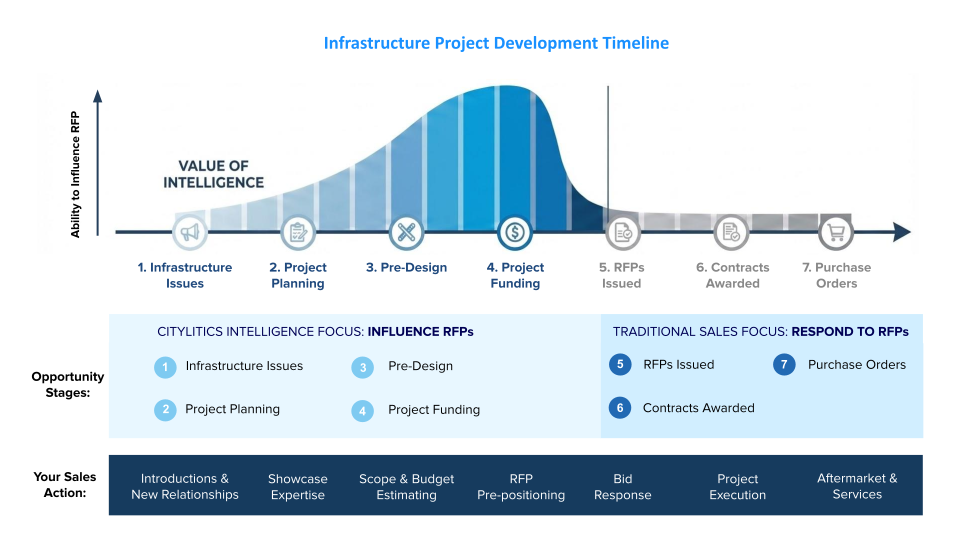
From Broad Needs to Defined Projects

Houston infrastructure moves through an adopted five-year capital program, project-level design and construction, and formal procurement under the responsible City owner. The 2027-2031 CIP establishes program funding and planned delivery by fiscal year. Individual capital profiles and solicitation records establish the exact project stage and contract timing.
Houston TX public infrastructure projects | Public Infrastructure Project Development Timeline
Citylitics impact: Intelligence Feeds surfaces early owner, agency, utility, planning, funding, and procurement-preparation signals. Capital Projects Dashboard connects those signals to future spend. Grant Funding Dashboards and Procurement Feeds add theme-specific context so teams can prioritize, prepare, and act before procurement compresses the timeline.
Procurement preparation

Where Houston Infrastructure Investment Is Concentrated

Houston's adopted 2027-2031 CIP concentrates current capital direction in water, wastewater and streets. Water priorities include treatment, transmission and main replacement. Wastewater funding covers sewer rehabilitation, lift stations, force mains and treatment facilities. Street funding covers citywide rehabilitation, thoroughfares, local streets and sidewalks. The five-year program provides a reliable market map, and individual project profiles provide the stage detail needed for project-specific research.
The 2027-2031 program is adopted, with delivery spread across five fiscal years
Houston labels the current water, wastewater and street chapters as the adopted FY2027-2031 Capital Improvement Plan. The chapters allocate funding by fiscal year and by project category. Adoption establishes the City's five-year capital program, and each project can still occupy a different stage within that program. Project profiles, council actions and procurement notices provide the next level of evidence for design, land acquisition, construction and contract timing. The published allocation tables also distinguish design and construction spending, which helps keep program-level capital direction separate from the exact status of an individual project.
Utility programs include both systemwide programs and named facilities
The water and wastewater chapters combine recurring system renewal with major facility work. Water priorities include East Water Purification Plants 1 and 2, transmission lines, pump stations and main replacement. Wastewater priorities include neighborhood sewers, force mains, lift stations and treatment plants. This structure supports account-level market planning. Project-specific pursuit timing follows the individual capital profile and the public owner's procurement record. The allocation tables show that both recurring renewal programs and named capital facilities can draw funding in the same five-year window, so owner and project records need to be read together.
Street funding includes current programs and projects deferred for future funding
The Street and Traffic Control chapter identifies current five-year funding for rehabilitation, thoroughfares, collectors, local streets and sidewalks. It also names several projects that were listed in prior adopted CIPs and are now deferred until additional funding is identified. That distinction keeps the page from turning a long-range project list into an active construction pipeline. Current budget allocation and project status need to be read together. That source-level discipline prevents a deferred corridor from being presented as funded construction and keeps current program totals tied to the work actually scheduled in the adopted plan.
Early signal read

What to Watch Next in Houston, TX Public Infrastructure

The live project previews below add current signal-level context for Houston, TX. Use them with the adopted CIP chapters to identify the responsible owner, confirm the documented project stage and follow project profiles, council actions and procurement records as individual scopes advance.
Wastewater - Lift Station Initiatives
City of Houston, TX - Pipe Initiatives
The City of Houston is planning a force main rehabilitation and reconstruction project within its wastewater lift station system with a budget allocation of $93,516.
Transportation - Road Initiatives
Montgomery County Drainage District 6, TX - Road Initiatives
Montgomery County Drainage District 6 has allocated $300,000 in its current budget to reconstruct Robinson Road as part of ongoing transportation and road initiatives.
Transportation - Road Initiatives
City of Houston, TX - Road Initiatives
The City of Houston is planning the second phase of its Emancipation Avenue and Polk Street reconstruction project, supported by a budgeted $2,048,405 as of September 2026.
Stormwater - Pipe Initiatives
City of Houston, TX - Pipe Initiatives
The City of Houston is planning a $500,000 initiative in fiscal year 2027 to upgrade stormwater pipe infrastructure and address localized flooding issues.
Ready to move earlier?
Review Houston, TX Public Infrastructure Projects
Request Intelligence Brief
Similar Regions

Similar Regions in This Market

Population-ranked peer municipalities and parent regions relevant to Public Infrastructure are listed below for comparison. Region names link to corresponding Citylitics pages only where those pages are available.
San Antonio
Dallas
Austin
Fort Worth
El Paso
Arlington
Corpus Christi
Plano
Lubbock
Laredo
Texas
Citylitics platform

Citylitics Intelligence for Houston, TX Public Infrastructure

Citylitics helps teams identify, qualify, position, and pursue public infrastructure opportunities with stronger market and account context. For Houston, TX, that means connecting capital programs, owner records and project signals so teams can focus on relevant activity and carry source-backed context into their existing workflow.
Core platform
Intelligence Feeds
Surface source-backed planning, funding, owner and project signals across the market so teams can identify relevant opportunities earlier.
Intelligence layer
REX AI
Investigate funding, timing, engineering involvement, project phase and source context around a relevant opportunity using source-backed research.
Capital planning
Capital Projects Dashboard
Review capital plans and future spend context to prioritize public owners, accounts and project categories that deserve deeper coverage.
Funding context
Grant Funding Dashboard
Bring public funding context into opportunity discovery and qualification where grants, programs and public financing records shape project movement.
Commercial signals

Current Commercial Signals in Houston

Houston's adopted 2027-2031 CIP provides direct capital-program signals across water, wastewater and streets. Each program carries a defined owner and funding framework, with project profiles supplying the next stage detail.
Water
Follow the $5.06B Water Utility System program
Houston's adopted FY2027-2031 Water Utility System CIP includes about $5.06 billion for treatment, transmission, main replacement, storage, pumping and related assets. The program continues major work at East Water Purification Plants 1 and 2 and across the distribution system. Project profiles and procurement records can then be used to identify the specific design, construction and equipment packages moving under the broader five-year program.
Wastewater
Track the $3.54B wastewater improvement program
Houston's adopted wastewater CIP includes about $3.54 billion for FY2027-2031 and covers a system with approximately 6,200 miles of sanitary sewer. The program includes sewer rehabilitation, force-main and lift-station renewal, treatment-plant upgrades and other consent-decree commitments. The adopted plan establishes the funding framework, and individual project records establish the exact delivery and procurement stage for each scope.
Streets
Use the $1.58B street program to map current mobility work
The Street and Traffic Control CIP allocates $1.58 billion for FY2027-2031, including $790 million for citywide rehabilitation and $512.7 million for thoroughfares and collectors. The chapter also identifies projects that have been deferred to future CIPs pending additional funding. This makes the current adopted program useful for market coverage, with project profiles and procurement notices needed to confirm which corridors are moving into design or construction.

PROJECT INTELLIGENCE FAQ

Frequently Asked Questions

The City of Houston’s current adopted Capital Improvement Plan covers fiscal years 2027 through 2031.

The adopted FY2027-2031 chapters allocate about $5.06 billion to the Water Utility System and about $3.54 billion to the Wastewater Treatment System.

The adopted plan establishes a five-year capital program. Individual project profiles and procurement records determine the current design, construction, funding and contracting stage for each project.

Sources and Methodology

Sources & Intelligence Methodology

Market and geographic context on this page is informed by official plans, budgets, capital programs, board materials, public records, and other government or public-owner sources. The early-stage project signals and pre-RFP opportunity previews are provided separately through Citylitics’ proprietary sales intelligence platform, which continuously identifies and tracks infrastructure opportunities as they develop toward procurement.

Water Utility System - FY 2027–2031 Adopted Capital Improvement Plan

City of Houston | 2026
Official adopted FY2027-2031 Water Utility System CIP chapter documenting approximately $5.06 billion in water-system improvements and current program priorities.

Wastewater Treatment Facilities - FY 2027–2031 Adopted Capital Improvement Plan

City of Houston | 2026
Official adopted FY2027-2031 wastewater CIP chapter documenting approximately $3.54 billion in improvements and the system’s 6,200-mile sanitary sewer network.

Street and Traffic Control - FY 2027–2031 Adopted Capital Improvement Plan

City of Houston | 2026
Official adopted FY2027-2031 Street and Traffic Control CIP chapter documenting $1.58 billion in improvements and major program allocations.

Prepared by Citylitics Market Intelligence Team

TL;DR

Houston's adopted 2027-2031 Water Utility System CIP allocates about $5.06 billion across treatment, transmission, main replacement and related assets.

The adopted wastewater program allocates about $3.54 billion and covers a system with approximately 6,200 miles of sanitary sewer.

Street and Traffic Control carries $1.58 billion for FY2027-2031, including major rehabilitation and thoroughfare programs.

Request intelligence
Request the Houston, TX Public Infrastructure Intelligence Brief
Request the Houston, TX Public Infrastructure Intelligence Brief for source-backed project context, owners, development stage, funding and procurement indicators that can support account prioritization and pursuit preparation.

Request Your Intelligence Brief

Phone number with International code

Before you go - Do you want free sample insights on upcoming projects?

Get free sample insights on early-stage infrastructure opportunities in your market.
Phone number with International code

Develop Your Market With the Right Opportunities

Choose your priority markets, we’ll share relevant insights and show how Citylitics can help you pursue and win the right opportunities.
Phone number with International Code
Phone number with International code
I agree to receive other communications from Citylitics.